Get Free Ebook FDR: The Beckoning of Destiny, 1882-1928, by Kenneth S. Davis
In reading FDR: The Beckoning Of Destiny, 1882-1928, By Kenneth S. Davis, now you may not also do traditionally. In this modern period, gadget and computer will assist you so much. This is the moment for you to open the gizmo and also stay in this site. It is the appropriate doing. You can see the connect to download this FDR: The Beckoning Of Destiny, 1882-1928, By Kenneth S. Davis below, cannot you? Merely click the web link and negotiate to download it. You can get to purchase guide FDR: The Beckoning Of Destiny, 1882-1928, By Kenneth S. Davis by on-line and also all set to download. It is extremely different with the conventional method by gong to guide establishment around your city.
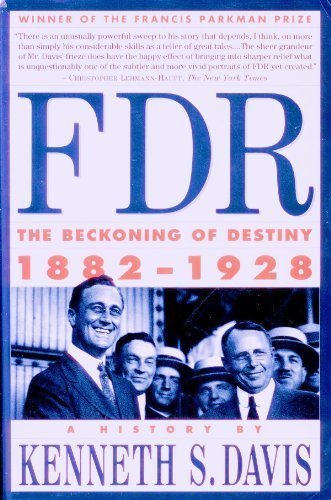
FDR: The Beckoning of Destiny, 1882-1928, by Kenneth S. Davis

Get Free Ebook FDR: The Beckoning of Destiny, 1882-1928, by Kenneth S. Davis
Some people could be chuckling when considering you reading FDR: The Beckoning Of Destiny, 1882-1928, By Kenneth S. Davis in your spare time. Some might be admired of you. And also some might really want resemble you that have reading pastime. What concerning your own feeling? Have you really felt right? Checking out FDR: The Beckoning Of Destiny, 1882-1928, By Kenneth S. Davis is a need and also a hobby at the same time. This problem is the on that particular will make you really feel that you need to read. If you recognize are searching for the book entitled FDR: The Beckoning Of Destiny, 1882-1928, By Kenneth S. Davis as the selection of reading, you could find here.
Even the rate of an e-book FDR: The Beckoning Of Destiny, 1882-1928, By Kenneth S. Davis is so affordable; many individuals are truly thrifty to allot their cash to purchase the e-books. The various other reasons are that they really feel bad and also have no time at all to go to the e-book establishment to search the book FDR: The Beckoning Of Destiny, 1882-1928, By Kenneth S. Davis to review. Well, this is modern era; so lots of books could be obtained effortlessly. As this FDR: The Beckoning Of Destiny, 1882-1928, By Kenneth S. Davis as well as more publications, they can be entered extremely quick methods. You will not have to go outside to obtain this e-book FDR: The Beckoning Of Destiny, 1882-1928, By Kenneth S. Davis
By seeing this web page, you have done the best gazing point. This is your begin to choose the publication FDR: The Beckoning Of Destiny, 1882-1928, By Kenneth S. Davis that you want. There are bunches of referred publications to read. When you intend to obtain this FDR: The Beckoning Of Destiny, 1882-1928, By Kenneth S. Davis as your e-book reading, you could click the link web page to download and install FDR: The Beckoning Of Destiny, 1882-1928, By Kenneth S. Davis In couple of time, you have possessed your referred books as all yours.
Because of this book FDR: The Beckoning Of Destiny, 1882-1928, By Kenneth S. Davis is sold by on-line, it will alleviate you not to publish it. you can get the soft data of this FDR: The Beckoning Of Destiny, 1882-1928, By Kenneth S. Davis to conserve in your computer system, device, as well as a lot more devices. It depends on your willingness where and also where you will check out FDR: The Beckoning Of Destiny, 1882-1928, By Kenneth S. Davis One that you have to always bear in mind is that checking out e-book FDR: The Beckoning Of Destiny, 1882-1928, By Kenneth S. Davis will never finish. You will certainly have prepared to review various other publication after completing a book, and it's constantly.
In this extraordinary biography, Roosevelt's life is set against the backround and events of almost half a century to show how the man and his career were shaped by the world in which he lived.
- Sales Rank: #2619310 in Books
- Brand: Brand: Random House
- Published on: 1993-10-12
- Released on: 1993-10-12
- Original language: English
- Dimensions: 9.25" h x 6.00" w x 1.50" l,
- Binding: Paperback
- 936 pages
- Used Book in Good Condition
From the Inside Flap
In this extraordinary biography, Roosevelt's life is set against the backround and events of almost half a century to show how the man and his career were shaped by the world in which he lived.
About the Author
A biographer of Eisenhower, Lindbergh, and Adlai Stevenson as well as a novelist, Kenneth S. Davis was awarded the prestigious Francis Parkman Prize for FDR: The Beckoning of Destiny, which was also a nominee for the National Book Award. In addition, his next two volumes on FDR were both chosen as among the ten best books of the year by The New York Times.
A graduate of Kansas State University, with a master of science degree from the University of Wisconsin and an honorary doctorate of letters from Assumption College, Davis was a journalism instructor at New York University, a war correspondent attached to General Eisenhower's headquarters, special assistant to Milton Eisenhower, the president of Kansas State University, a member of the State Department's UNESCO relations staff, editor of The Newberry Library Bulletin in Chicago, adjunct professor of English at Clark University, and an adjunct professor of history at both Kansas University and Kansas State University. Kenneth S. Davis died in June 1999.
From the Hardcover edition.
Excerpt. � Reprinted by permission. All rights reserved.
BOOK ONE
A Guided Drift Toward War
Overture: Themes, Issues, Recapitulations
"We are facing difficult days in this country, but I think you will find me in the future just the same Franklin Roosevelt you have known a great many years."
Roosevelt had spoken these words at midnight of the night before (it was now Wednesday morning, November 6, 1940) to a jubilant crowd of Hyde Park neighbors gathered on the wide Big House lawn—a crowd that had come in torchlight parade to celebrate with him his election to an unprecedented third term as President of the United States, defeating Republican challenger Wendell Willkie—and the promise thus made, despite being rendered strangely tentative and even dubious by the prefatory "I think," was evidently intended by him to soothe, to reassure. It failed to do so, however, for everyone who listened to it or read it in the papers. There were critical and well-informed minds in which the promise raised questions of identity that, viewed in terms of the future now rising as black clouds out of Europe, out of Asia, to cast gloom over the Republic,
were both difficult to answer and profoundly disturbing.
Was this "Franklin Roosevelt" whom his listeners had "known a great many years" actually and wholly the Roosevelt upon whom now depended so much of the fate of America and, indeed, the world? Or was the "real" Franklin Roosevelt a man different in important ways, and perhaps contradictory ways, from his Hyde Park friends' perception of him? In either case, but especially in the latter, to what extent and in what ways would his remaining "just the same" be a boon for mankind, to what extent and in what ways a misfortune, in the "difficult days" to come?
II
The man popularly perceived, the man whose face at midnight had been cooled by a mild springlike breeze as it was imbued by ruddy torchlight, was a big, warm, friendly, compassionate man with an acute sense of justice and a strong commitment to it. Through all the fifty-seven years
of his life (he would be fifty-eight this coming January 30) he had been a lover of simple country living. He disliked cities, though his most solid political support came from urban areas, and had in the past, in public speech, more than hinted a belief that virtue, discouraged by the frenetic
artificiality of crowded streets, could come to its full flowering only amid green growing things in such landscapes as the one he saw this morning out his bedroom window. For though the green growth was now in autumn retreat at Hyde Park, the hardwoods leafless, the evergreens nearly
black, the fields and meadows gray and brown and swept by chill winds under a darkly lowering sky (the weather, he noted, had greatly changed since midnight)—though this was so, and though the present melancholy of it was felt, the window-framed landscape of wide fields and wild-wooded
hills was yet seen through memory's eyes as a greenly living one. Through it, nourishing and ordering it, flowed the great theme-river of his life, the mighty Hudson, upon whose wide bosom he had spent many of his happiest youthful hours in sailboat and iceboat and from whose bank he and his devoted friend Louis Howe had launched the model sailboats they designed and built together during his long convalescence, as a middle-aged man, from near fatal illness. It now presented itself to his vision, beyond a fringe of treetop, as more lake than stream. A small inland sea. And it
was in fact both an active arm of the sea and an active contributor of water to the sea, for it was one of the longest estuaries on earth, as Roosevelt had learned as a boy. Already, as it made its slow curve around Crum Elbow, it sometimes tasted faintly of the salt of the sea that flowed into it, if meagerly, at high tide, and into which soon it must die. Such facts greatly interested, and were known to interest, the man whom his neighbors had long known. He collected them avidly and, his admiring neighbors would have said, they now richly furnished a mind remarkable for
its capacity.
Many of these neighbors knew, as we know, that his collecting of facts, like his collecting of stamps, old books, naval prints, and the like, had been a major part of the psychological strategy he had employed, to sustain his morale, in the long hard war he had waged—much of it in this house, in this very room—against the crippling effects of the polio that had struck him down in 1921, when he was thirty-nine. It was a war he had declared in the innermost recesses of his being, and to everyone around him, while he was yet wholly bedridden, unable even to sit erect. With an iron determination whose grimness he masked with smiling outward confidence, even gaiety, he had set out to conquer and destroy his affliction. He would walk again! He would walk unaided, without leg braces or crutches or canes! Alas, he never did. He became more mobile, less helpless physically, than had seemed possible to his doctors at the outset of his war, but no amount of willpower or arduous physical effort (he expended prodigious quantities of both) could regrow destroyed nerve tissue. In 1928, when his return to active political life forced him to suspend his recovery regimen after seven years of harsh effort, his legs yet remained nearly fleshless, hardly more than sticks of bone draped in wrinkled skin, and were almost totally unresponsive to his will. His public "walking" and "standing," in 1928 as in 1940, were difficult and often painful balancing acts on what were in effect stilts (steel rods locked around hips, knees, ankles), possible only if he leaned heavily on canes or had beside him a strong man whose arm he could grip. Nevertheless, his struggle had been far from fruitless. During it, as his neighbors knew, he had manifest and further developed an almost incredible fortitude, patience, and emotional self-control—a self-mastery that was part and parcel of his mastery of other people.
Discerned by some of the more acute of those who observed him with close attention, though from a distance, was the fact that his very disability had become in his way of handling it a source, an instrument, a protector and preserver of personal power. As regards this last, it prevented risk-engendering importunities that he could not have avoided, save at the further and possibly greater political risk of giving offense, had he been able to move freely about and therefore compelled to mingle casually with other people on occasions and grounds not of his choosing. The compulsion was now all the other way: people must come to him, and they must come always, to some extent, at least, with formality—that is, in accordance with formal rules whereby they were placed at an initial disadvantage insofar as their dealings with him were of an adversarial nature. This was true even in situations where his actual need for their support was considerably greater than theirs for his. For since they came as invited guests into his house, or by his permission into his office or onto other ground ruled by him, they came perforce under felt obligations and must
assume in some degree, willy-nilly, a supplicatory attitude. By the manner of his welcome or greeting he could and did set the tone of every personal encounter and, having done so, could and did dominate the discussion.
Similar in effect, but different psychologically, was the way in which his physical handicap became per se a source and instrument of governing power. Conjoined or (more precisely) fused with the self-mastery he had gained through his struggle to overcome it, his perceived handicap, in part by weakening in other people their inward resistance to his will, actually increased his persuasiveness and enhanced his ability to command through sheer force of personality. It commonly made these others want at the outset to please, emulate, and, if at all possible, agree with this man who demonstrated so much courage, strength of character, and optimistic confidence—so much liking and concern for them personally, such sweetness of disposition—under pressures that would have crushed an ordinary mortal into chronic depression and resentful dependency. Moreover there was a natural assumption on the part of people in general, an assumption abundantly encouraged by his careful management of his public image, that he had earned through his prolonged and terrible ordeal a compassionate living wisdom remarkable for its width and depth. He was therefore commonly deemed more likely to be right than his opponents were on issues concerning which the common view was not well informed. He might be so even on issues of which his own factual knowledge was meager: his "intuition" was famous, was encouraged by him so to be—an ability, as it seemed, to dispense with logical process as he plunged with lightning swiftness into the heart of a difficult problem and discovered there its solution—and though it was presumed that he had been born with this uncanny ability, it was further presumed that prolonged anguish and arduous struggle had sharpened and strengthened it.
From the Hardcover edition.
Most helpful customer reviews
6 of 6 people found the following review helpful.
Davis lacks focus
By D. M. Nott
Let me start by saying that Kenneth S. Davis is a naturally talented writer and historian and this biography is very informative and entertaining. However it is simply too bloated, it does not just want to be a biography of FDR but a history of the aristocratic Hudson River society, Groton, Harvard, Tammany Hall and the Woodrow Wilson administration. I am a firm believer in a model of biography that puts the subject in their historical context, since no person can be understood without looking at the kind of envirnoment that formed their actions.
However Davis simply takes this too far by focusing on these particular aspects of the biography without really any explanation of why this is essential to understanding the character of Franklin D. Roosevelt. Davis is also to fixated on Eleanor and parts of the biography ignore his role in their relationship and focus on her life.
Overall this is a well written, compelling biography but it is simply too long and there are parts where the man himself gets lost in the world surrounding him. The fact that this volume is 853 pages and only gets as far as his election as the governor of New York shows how overblown the book is. Overall more editing was required to make this volume flow better and to give us a sense of Rooselvelt himself, this is a shame since this biography has so much more going for it.
4 of 4 people found the following review helpful.
How it all began...
By M. A Newman
This book was awarded a well-deserved Parkman for the quality of its scholarship. This is the best book on the early years of FDR. It follows his childhood and explores the relationships with the key people in his life: the formidable Sara Delano Roosevelt, his marriage to Eleanor, and his political education from Louis Howe.
This book also has a great deal to say about polio and how FDR and each of these people responded. This is not "Sunrise at Campabello, although it is clear that polio did make Roosevelt into the person who was able to become the greatest president of the 20th century.
6 of 6 people found the following review helpful.
Huge biography that reads at the pace of a great novel.
By A Customer
I can't wait to read the other books in this serial biography. Davis rarely overtells or undertells details of FDR's early years. The book moves quickly, and leaves an insatiable desire to read the next installation - if you can find it.
FDR: The Beckoning of Destiny, 1882-1928, by Kenneth S. Davis PDF
FDR: The Beckoning of Destiny, 1882-1928, by Kenneth S. Davis EPub
FDR: The Beckoning of Destiny, 1882-1928, by Kenneth S. Davis Doc
FDR: The Beckoning of Destiny, 1882-1928, by Kenneth S. Davis iBooks
FDR: The Beckoning of Destiny, 1882-1928, by Kenneth S. Davis rtf
FDR: The Beckoning of Destiny, 1882-1928, by Kenneth S. Davis Mobipocket
FDR: The Beckoning of Destiny, 1882-1928, by Kenneth S. Davis Kindle

Tidak ada komentar:
Posting Komentar